


Selective Laser Sintering
Post-processing and Surface Technology
Additional Services
Vibratory Finishing of SLS 3D Printed Parts
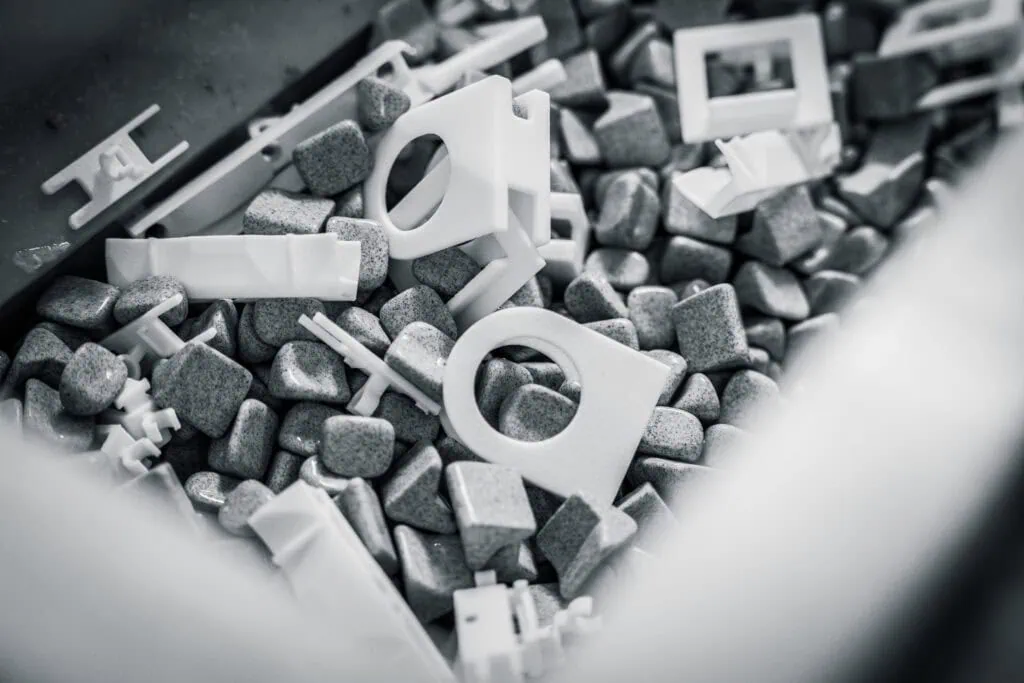
In this process, the 3D-printed parts to be smoothed are placed in a vibrating trough for several hours together with a processing medium (ceramic grinding stones) and an aqueous additive (compound). The vibration creates a relative movement of the component to the processing medium, and the grinding stones remove a small amount of material from the surface of the part. This material removal ensures smoothing of the part surface. Due to their smooth surface, vibratory finished SLS components are less prone to dirt adhesion and have an improved feel.
Advantages of Vibratory Finishing
Ideal for parts that…
- should also be smoothed cost-effectively in series
- require an improved tactile feel
- should be easy to clean and less prone to dirt adhesion

Possible Surfaces
SLS components made of PA2200 (PA12 white) have an approximate surface roughness of Ra=11.7 µm and Rz=64.6 µm without special post-processing. By vibratory finishing, these roughness values can be improved to Ra=2.6µm and Rz=22.5 µm.
Compatible Materials
- PA2200 (PA12 white)
- PA2201 (PA12 translucent)
- PA3200GF (PA12 glass-filled white)
- Alumide (PA12 with Aluminum)
- PA2241FR (PA12 flame-retardant white)
- PA2210FR (PA12 flame-retardant white)
- PA1101 (PA11 white)
Frequently Asked Questions - Tumbling
After the printing process, SLS components have a relatively rough surface. Tumbling mechanically smooths this surface, giving the components a more pleasant feel and a higher-quality appearance. At the same time, dirt or deposits adhere significantly less to the surface.
During tumbling, the components are placed in a vibrating trough along with ceramic abrasive media and an aqueous additive. The movement creates a relative motion between the component and the abrasive media, which slightly removes material from the surface and smooths it.
Generally, tumbling is more cost-efficient than chemical smoothing, especially for larger quantities or series production. The process can be used very effectively for many components simultaneously and requires fewer complex process steps. While chemical smoothing produces a significantly smoother and almost pore-free surface, it is usually associated with higher costs.
Tumbling typically increases the lead time of a component by about one additional day. The components usually remain in the tumbling trough for around 20 hours, during which the surface is continuously smoothed. Afterwards, the parts are cleaned and prepared for further processing steps or shipping.
In tumbling different abrasive media are used depending on the component geometry These can have various shapes and sizes: round small, large or triangular The selection always depends on the geometry of the component and the desired surface finish.. The selection always depends on the geometry of the component and the desired surface finish.. For components with internal channels or cavities, special care must be taken to ensure that no abrasive media get stuck in the component.