


Selective Laser Sintering
Post-processing and Surface Technology
Additional Services
Infiltration of SLS 3D Printed Parts
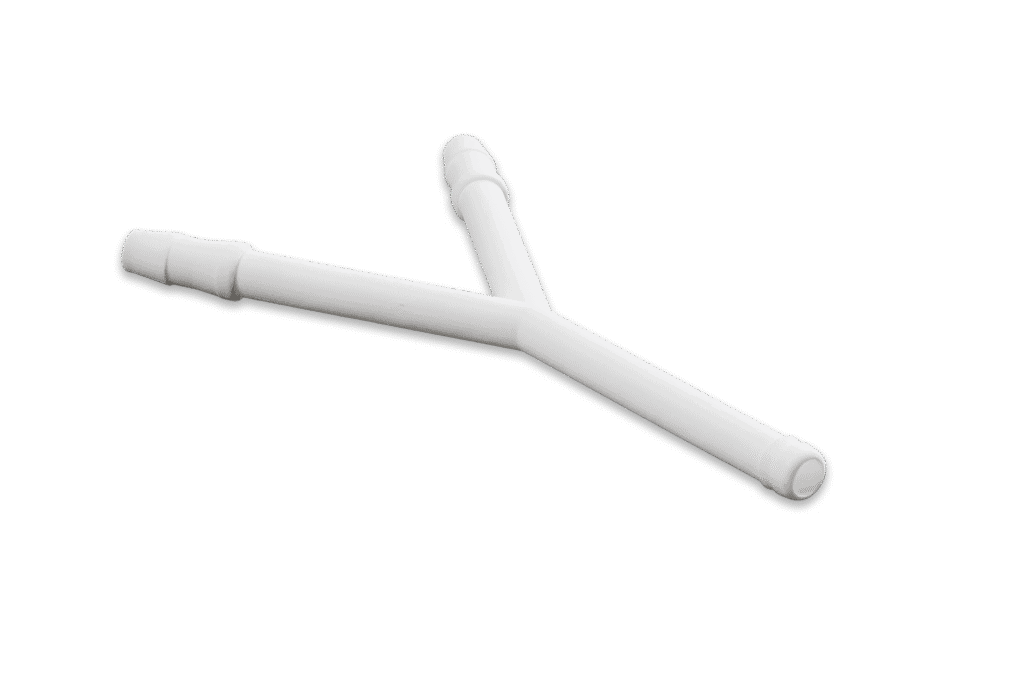
In this process, a one-component high-performance polymer is applied to the component surface, which completely closes and seals the pores of the otherwise slightly porous surface of laser-sintered parts. This sealing or impregnation prevents water or gas from penetrating the component surface. Depending on the geometry, SLS parts are dipped in high-performance polymer or coated or sprayed with it. Infiltrated SLS components have drinking water and food approval and are characterized by excellent weather resistance. For laser-sintered components that need to be 100% leak-proof even under high pressure, we recommend our chemical smoothing post-processing method.
Advantages of Infiltration
Ideal for parts that…
-
Need to be sealed cost-effectively
-
Need to be weather-resistant
-
Need to be leak-proof against gases and liquids at low differential pressure

The 1K high-performance polymer used
We use the one-component high-performance polymer Dichtol from DIAMANT Polymer GmbH to infiltrate our SLS parts to make them watertight or gas-tight. Cured Dichtol is non-critical for contact with food or drinking water and is permanently temperature-resistant up to 300 °C.
Compatible Materials
- PA2200 (PA12 white)
- PA2201 (PA12 translucent)
- PA3200GF (PA12 glass-filled white)
- Alumide (PA12 with Aluminum)
- PA2241FR (PA12 flame-retardant white)
- PA2210FR (PA12 flame-retardant white)
- PA1101 (PA11 white)
Frequently Asked Questions - Infiltrating
During infiltrating, a one-component high-performance polymer from the company Diamant Polymer (Dichtol) is applied to the surface of an SLS part. It penetrates the pores of the slightly porous surface and seals them so that liquids or gases can no longer penetrate the material. .
The choice between infiltrating and chemical smoothing depends primarily on the required leak-tightness of the part. During infiltrating, a polymer penetrates the pores of the surface and partially seals them. This makes parts significantly more resistant to liquids or gases, and the process is usually a cost-effective solution—however, as a rule, the parts do not become fully pressure-tight. During chemical smoothing, the uppermost material layers arepartially dissolved, causing the pores to close completely. This creates a very smooth surface, and the part can even become 100% pressure-waterproof. Chemical smoothing is therefore used when particularly high leak-tightness or a premium surface finish is required.
Infiltration closes the pores in the part’s surface, making the part significantly more resistant to water, gases, and environmental influences. This makes the process particularly suitable for functional technical parts or housings that come into contact with liquids.