


Your industrial high-tech SLS 3D printing service provider
Welcome to prioadd – your partner for professional SLS 3D printing. With modern and powerful laser sintering systems, we manufacture functional prototypes, small series, series and complex individual parts – reliably, precisely and in the shortest possible time.
We focus on clear communication, fast response times and results that deliver on their promises. No detours, no waiting, no compromises.
Responsive, flexible, and on the ball – that’s modern 3D printing.
You bring the idea – we make the part.
Additive Manufacturing Using the SLS Process

Selective Laser Sintering (SLS) is an additive manufacturing process in which components are built up layer by layer from powdered material. A laser selectively fuses the areas of a thin powder layer that correspond to the respective cross-section of the component. Subsequently, a new layer of powder is applied and fused again by the laser. This process is repeated layer by layer until the component is fully built. The surrounding, non-sintered powder serves as support material and enables even complex geometries without additional support structures.
In practice, the SLS process predominantly uses polyamides, as they offer high strength, good dimensional stability, and versatile application possibilities for functional components while being reliably processed in laser sintering.
Our competencies at a glance

Selective Laser Sintering
For the production of your 3D printed components, we have five industrial SLS 3D printers and eight different materials available. We produce exclusively on systems from the manufacturer EOS and use only original materials from EOS. The typical lead times for prototypes and small batches are generally around 3 to 5 working days.

Post-processing and Surface Technology
To ensure your component optimally meets your requirements, we offer eight different post-processing methods. These include various methods for coloring components as well as techniques for smoothing the surface of your SLS parts. Mechanical post-processing such as threading, reaming of fits, or milling of components on a CNC machine is also possible.

Engineering
We support you in implementing your idea and adapt your components so that they are optimally suited for production using the laser sintering process. We work with state-of-the-art CAD technology and a team of designers and specialists who have extensive experience in optimizing geometries for SLS 3D printing.

Quality Assurance
In our in-house measurement laboratory, we can measure your SLS components precisely according to your requirements. Whether first article inspection report, measurement protocol, or false-color actual-nominal comparison—we provide the appropriate evaluation. For this, we use a GOM ATOS Capsule 3D scanner, which allows components to be measured contact-free, precisely, and time-efficiently.
Product examples

Bone model
Single piece | Research
Material: PA2201
Post-processing: Chemical smoothing
Use: This bone model is a true-to-scale replica of a wild boar pelvic bone. The model was manufactured for a biological institute and serves as a demonstration object.

Topology-optimized structural component
Small series | Model making
Material: Alumide
Post-processing: –
Use: This topology-optimized Alumide component is part of a chassis suspension of a model car. The geometry of the component is optimized by simulation according to the force flow under load, so that the component can transmit as much load as possible with as little weight as possible.

Housing with pad printing
Small series | Electronics industry
Material: PA2210FR
Post-processing: Compaction blasting, dip dyeing black, pad printing
Use: This two-part housing contains the circuit board or the control system, which automatically secures an elevator from crashing in the event of an emergency. Due to the material PA2210FR, the housing is certified according to UL94 / V-0. The two housing parts are connected to each other by a one-time clip connection. The pad printing allows important status LEDs to be interpreted directly.

Conveyor screw
Single piece | Special machine construction
Material: PA2200
Post-processing: Compaction blasting
Use: This conveyor screw continuously conveys cylindrical components in a machine for automating a series injection molding process. The cylindrical components are picked up by a robot and inserted into the injection molding tool before each production cycle.

Sheet metal bending prototype
Prototype | Sheet metal bending
Material: PA2200
Post-processing: –
Use: In order to test a new sheet metal bending tool and to set the sheet metal bending machine correctly, this component is first manufactured using the SLS process. It is then used to optimally coordinate the machine and tool with each other.

Pump housing
Functional prototype | Mechanical engineering
Material: PA3200GF
Post-processing: Infiltrate
Use: In order to build a functional prototype of a pump in an industrial dishwasher, the pump housing is first SLS printed. The infiltration makes the housing watertight and ready for initial tests under real conditions.

Gasometer
Single piece | Architecture
Material: PA1101
Post-processing: –
Application: This gasometer is part of a complex architectural model. Due to the model’s intricate nature, it was manufactured on an EOS P110 using PA11. This material-machine combination is ideal for models with thin wall thicknesses and fine details.

Y-piece
Small series | Medical technology
Material: PA2200
Post-processing: Infiltrate
Use: This hose connector is used in medical technology for so-called colon hydrotherapy. This therapy is a medical procedure for cleaning the intestines. The infiltration makes the component resistant to liquids.

Windshield washer system
Functional prototype | Automotive industry
Material: PA2200
Post-processing: Chemical smoothing
Use: During the development of a new windshield washer system in the automotive sector, this functional prototype was additively manufactured in an intermediate stage of development in order to test it under real conditions in the test vehicle. The chemical smoothing makes the housing watertight even at higher differential pressures.

Joint component
Prototype | Aviation industry
Material: PA2241FR
Post-processing: Compaction blasting
Use: This joint component is part of a cargo securing system for aviation. In order to verify the design for later series production and to carry out an initial installation test, the component is first SLS 3D printed. Since the component is made of a flame-retardant material, initial fire protection tests can also be carried out here.

Bracket
Small series | Aviation industry
Material: PA2241FR
Post-processing: Compaction blasting
Use: This SLS 3D printed bracket is part of a door locking mechanism on an aircraft door. The material PA2241FR is used here because it is certified for use in aviation.

Hose connector
Series | Mechanical engineering
Material: PA1101
Post-processing: Chemical smoothing
Use: This curved Y-shaped hose connector safely directs hot cooling water around the corner and evenly divides the cooling water flow from one to two hoses. Due to the high temperature of the liquid, the material PA1101 is used here, the melting point of which is just over 200°C.

Housing with film hinge
Prototype | Electronics industry
Material: PA2201
Post-processing: –
Use: This proof-of-concept housing prototype contains a circuit board with several status lights. Due to its slight translucency, the material PA2201 is very suitable for housings through which status LEDs are intended to shine. The 180° film hinge is also fully functional when the component is manufactured from PA2201.

Housing seal
Small series | Mechanical engineering
Material: TPU1301
Post-processing: Chemical smoothing
Use: This seal seals the housing of an air blower. The chemical smoothing of seals made of TPU1301 makes them pressure-tight and therefore ideal as seals for functional prototypes or small series.

Dental model
Small series | Medical technology
Material: PA1101
Post-processing: –
Application: This dental model is used to train orthodontists in handling palatal screws. During the training, orthodontists insert real palatal screws into the model at various points. The material and wall thickness of the model are chosen to simulate the insertion resistance of a real jaw as closely as possible.

Motor mount
Series | Aviation industry
Material: PA3200GF
Post-processing: Melting in four M3 threaded bushings
Use: One of four electric motors of the drive of a delivery drone is attached to this motor mount, which is made of a glass-filled PA12. Due to the high rigidity and strength of PA3200GF, this material is used here. The melted-in threaded bushings make the motor attachment durable and well-suited for the dynamic loads in flight.
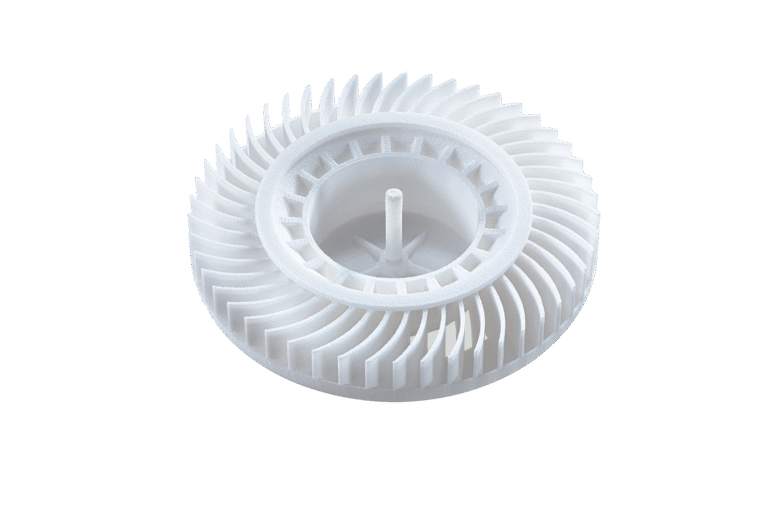
Impeller
Functional prototype | Automotive industry
Material: PA2200
Post-processing: –
Use: This impeller is installed and tested as a functional prototype in the seat cooling of an automobile seat before the geometry is implemented in the series injection molding tool. During product development, various blade geometries and spacings were tested here.

Impeller
Functional prototype | Electronics industry
Material: PA2200
Post-processing: –
Use: This impeller is used as a functional prototype for the design verification of a circuit board or electronics cooling system. Later, the component will be mass-produced in injection molding.

Seal
Small series | Electronics industry
Material: TPU1301
Post-processing: –
Use: This SLS printed seal seals a brightness sensor housing, which consists of two housing halves, against splash water and dust. During assembly, the two housing halves are screwed together with the seal in between. By pressing the seal between the two housing halves, the sensor inside the housing is well protected against environmental influences.

Motor mount
Single piece | Special machine construction
Material: Alumide
Post-processing: Recutting two M8 threads
Application: This component serves as a mount for an electric motor in a packaging machine. The high thermal conductivity of the aluminum-filled PA12 material ensures that the motor does not overheat and heat is dissipated effectively.

Camera cover
Small series | Electronics industry
Material: PA2200
Post-processing: Compaction blasting, dip dyeing black
Use: This cover protects a camera, which measures the degree of cloud cover in the sky, from environmental influences. The device in which this cover is installed predicts the electrical output of solar parks using artificial intelligence, making renewable energy more predictable and easier to integrate into the power grid.

Connector housing
Small series | Electronics industry
Material: PA2200
Post-processing: Dip dyeing black
Use: This is the half-shell of a connector housing that connects an engine control unit to a programming device. The connector was dip-dyed black after the laser sintering process.

Box with film hinge
Small series | Lifestyle
Material: PA1101
Post-processing: Compaction blasting, dip dyeing red
Use: This box is used to protect interchangeable ball bearings from dirt in the professional downhill skate area. The box is manufactured in small series from PA11. Due to its high elongation at break, PA11 is ideal for components with functional film hinges.

Gear wheel
Small series | Special machine construction
Material: Alumide
Post-processing: Reaming the central bore with 8H7
Use: This gear wheel is installed in a multi-stage gearbox of a textile machine. The material Alumide is used here due to its high rigidity, durability and wear resistance.

Corner clip
Trade fair prototype | Furniture industry
Material: PA2200
Post-processing: Chemical smoothing, dip dyeing black, pad printing
Use: This clip serves as a corner cover for a height-adjustable desk. Since the series injection molding tool could not be manufactured quickly enough, 20 of these components were additively manufactured using the SLS process for the presentation of the desk at a trade fair.

Prosthesis
Single piece | Medical technology
Material: PA1101
Post-processing: Vibratory grinding, compaction blasting, dip dyeing black
Use: This leg prosthesis is tailor-made and precisely tailored to the patient. PA11 is the material of choice here, as the material does not splinter when broken, thus ensuring the safety of the patient. The post-processing makes the prosthesis durable and sufficiently robust for daily use.

Camera mount
Single piece | Special machine construction
Material: PA2200
Post-processing: Vibratory grinding, chemical smoothing, dip dyeing
Use: We use these camera mounts on our SLS machines to monitor the construction process. For example, if there is a system error on the weekend, we will notice it and have the opportunity to restart the machine. Camera monitoring is particularly important when we are implementing very urgent projects for you and the delivery date must not be postponed under any circumstances.

Pump housing
Trade fair prototype | Mechanical engineering
Material: PA2200
Post-processing: Painting
Use: This component is used as a presentation model at the presentation of a new radial pump at a trade fair. The painting allows the exact color of the later series injection molded component to be imitated quickly and cost-effectively.

Screw model
Trade fair models | Medical technology
Material: PA2200
Post-processing: Tumble finishing, Painting
Application: These screws are 20:1 scale models of orthodontic jaw screws. Such jaw screws are used, for example, to precisely move teeth within the jaw. These screw models serve as demonstration and explanatory exhibits at medical technology trade fairs. The metallic-look paint finish makes the large models visually very similar to the actual screws.
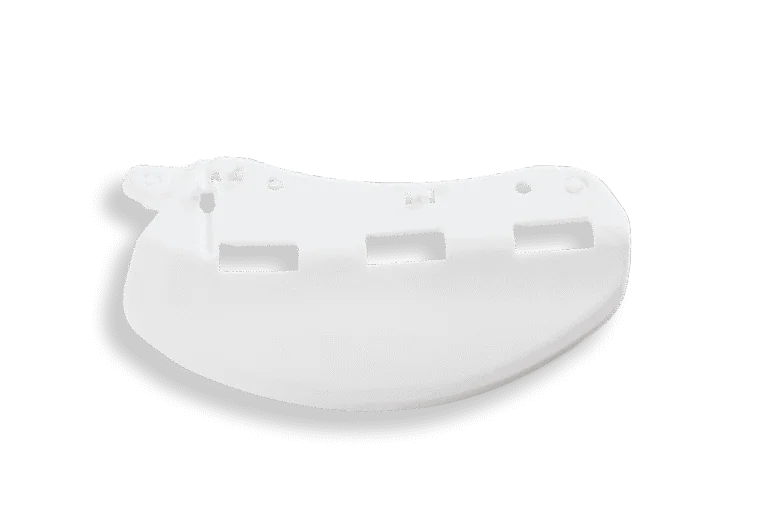
Car seat structural component
Prototype | Automotive Industry
Material: PA2200
Post-processing: Chemical smoothing
Application: This proof-of-concept prototype is installed in the backrest of a car seat during an installation test to verify if the subsequent component geometry is suitable for series production.

Cable tray
Series | Mechanical engineering
Material: PA2210FR
Post-processing: Black dip dyeing, Infiltration
Application: This cable tray is additively manufactured in series production and is used in a state-of-the-art container crane. Due to its geometry, an injection molding tool would not be cost-effective. Infiltration makes the component robust and weather-resistant. By using PA2210FR material, the component is UL94 / V-0 certified.

Motor housing
One-off Production | Automotive Industry
Material: PA3200GF
Post-processing: Tapping an M4 thread
Application: This motor housing encloses one of four electric motors in the drivetrain of a Formula Student race car. The complex geometry of the component can only be manufactured additively. PA3200GF material is ideally suited here due to its high dimensional stability and stiffness.

Seal
Small Series Production | Chemical Industry
Material: TPU1301
Post-processing: –
Application: This laser-sintered gasket made of thermoplastic polyurethane has a diameter of 70 mm and is installed in a flange connection of a piping system.
3-5 working days standard delivery time

Process overview
After receipt of order, we start directly with the production. The components are printed within 1 to 2 days and then require 1 to 2 days to cool down in the powder cake. After unpacking, glass bead blasting takes place and – depending on your wishes – further post-processing before we ship the parts. We ship your components so that they arrive the next day.
Express Manufacturing: Fast SLS 3D Printing
If things are really urgent, we can get your parts on their way in under 24 hours – without compromising on quality. We pull out all the stops for this:

- Place components on running jobs – saves construction time
- Express printing on a small machine – especially for urgent orders
- Hot unpacking, if the component allows it – saves cooling time
- Express shipping or direct courier – so that no time is lost along the way
We give it our all for you – and push the limits of SLS 3D printing so that you have your part in your hands on time.
Additive series production
Our daily business includes not only the production of prototypes, but also the implementation of series projects using SLS 3D printing. Depending on the component size and geometry, quantities of up to 100,000 pieces/year can be economically manufactured using the SLS process.

With modern production facilities, optimized processes and high repeatability, we produce series parts with consistent dimensional accuracy and surface quality – without tools or long lead times. For consistently high quality, we offer you series-accompanying measurements in our in-house measuring laboratory.
Our Values - Speed, Flexibility, Honesty, Efficiency
Our work is based on clear values: speed, flexibility, honesty, and efficiency. We know that projects often arise under time pressure. That is why we respond quickly to inquiries, think solution-oriented, and implement projects without unnecessary detours. At the same time, we remain flexible to reliably realize even short-notice changes or special requirements.

Open and honest communication is the foundation of every collaboration for us. We clearly state what is possible—and also when something is not sensible or economical. This creates solutions that truly work. Through efficient processes, modern systems, and extensive experience in SLS 3D printing, we ensure that your components are manufactured quickly, reliably, and in the desired quality.
Frequently Asked Questions - SLS 3D Printing
We are an industrial service provider for SLS 3D printing (Selective Laser Sintering) and specialize in the additive manufacturing of high-quality plastic components. We support our customers from prototype development through functional individual parts to small-batch and series production. With modern industrial 3D printing systems, we enable the fast and economical production of complex components without costly tooling. Additionally, we assist with component optimization and offer various post-processing and quality processes to achieve optimal results for every application.
prioadd is among the particularly fast SLS 3D printing service providers in Germany. Through modern industrial SLS 3D printing systems, optimized production processes, and efficient project execution, many components can be manufactured within just a few days. Especially for prototypes, development projects, or urgent small batches, customers benefit from short production times and fast delivery.
SLS stands for Selective Laser Sintering. In this 3D printing process, plastic powder is fused layer by layer into stable components using a laser. The process is particularly suitable for complex geometries, functional prototypes, and series components without tooling costs.
Yes, prioadd offers various post-processing methods for additively manufactured SLS parts. These include tumbling, dyeing, chemical smoothing, painting, infiltration, shot peening, pad printing, or mechanical post-processing.
Yes! The engineering team supports the optimization of components for SLS 3D printing to ensure they can be manufactured economically and technically optimally.
To ensure consistently high quality of manufactured components, prioadd employs several coordinated quality assurance measures. These include dimensional inspections, visual inspections, as well as monitored and documented manufacturing processes during SLS printing. Depending on project requirements, components can additionally be measured or subjected to further inspections to ensure they meet the required technical specifications and quality standards.
For a quote, you can easily submit your 3D data via the inquiry form on our website. Alternatively, you can send your inquiry by email to info@prioadd.de. After reviewing your data, you will receive an individual quote for the production of your components!
prioadd processes various high-quality thermoplastic materials for industrial SLS 3D printing, particularly polyamides such as PA12 and PA11. These materials offer high strength, good chemical resistance, and are ideal for functional prototypes as well as series components. Additionally, special material variants such as glass-filled polyamides for particularly rigid components, alumides with a metal-like appearance, and flexible materials such as TPU are available. For applications with increased safety requirements, flame-retardant materials can also be used.
Almost. With our SLS 3D printing, we can produce a wide range of complex plastic components—from functional prototypes to technical components and series parts. Very complicated geometries are usually not a problem for us. Limitations are more likely set by the build volume, the material, or sometimes simply physics. If you are unsure whether your component is suitable, send us your data—we will gladly review it and tell you honestly what is possible.
Sometimes yes—but unfortunately we cannot work magic yet. Thanks to our industrial SLS 3D printing systems and optimized processes, many components can be manufactured within just a few days. How quickly it actually happens depends on factors such as component size, quantity, material, and current capacity. Simply send us your 3D data—then we will quickly tell you when you can have your component in hand.