


Selective Laser Sintering
Post-processing and Surface Technology
Additional Services
Our SLS Machine Park for Industrial 3D Printing
SLS Machines at a Glance
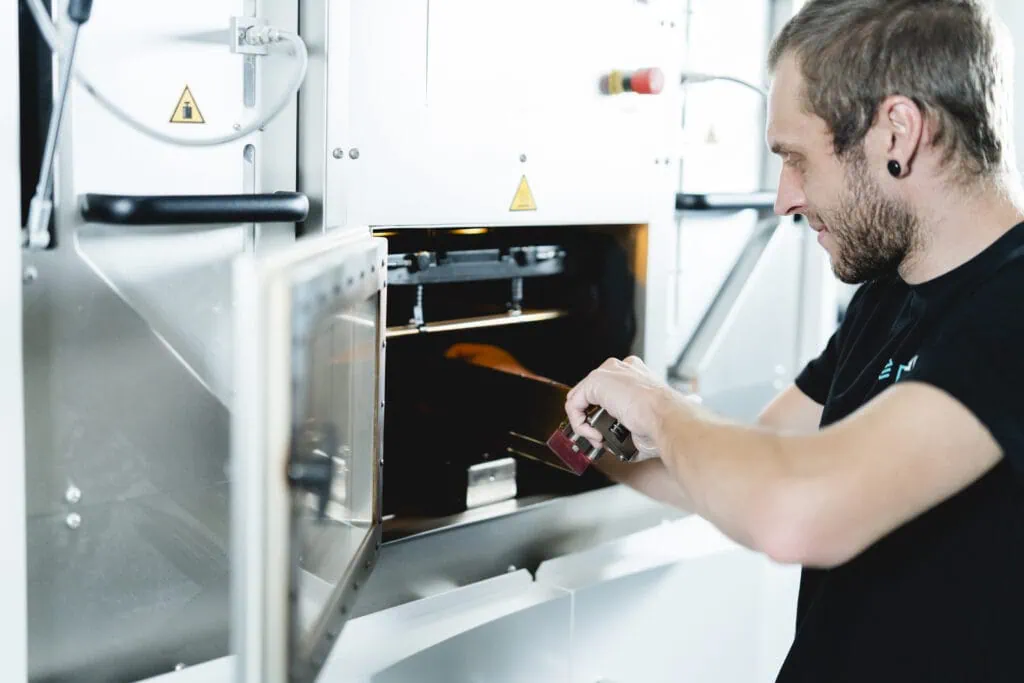
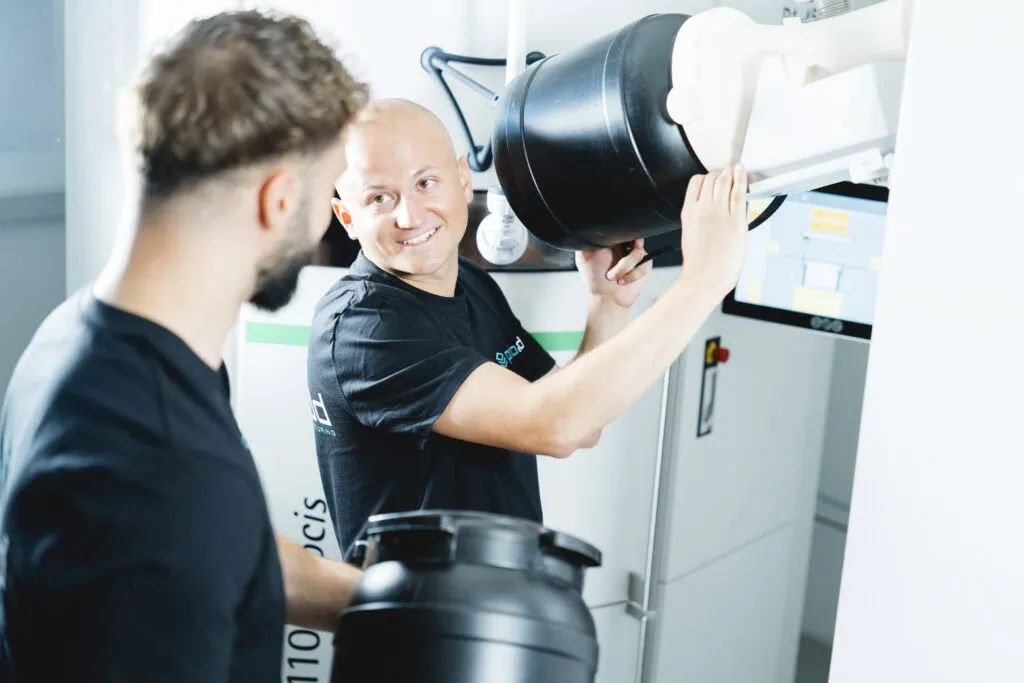
We are constantly investing in our machinery and expanding our production capacities to meet the increasing demand for fast and high-quality SLS components. We currently operate five industrial and modern laser sintering systems from EOS. The SLS systems of the German company Electro-Optical Systems (EOS) are characterized by their high reliability and construction speed. All our machines are designed for the series production of SLS components and are ready to produce components 24 hours a day, 7 days a week.
SLS Machines
1x EOS P100 Formiga
2x EOS P110 Formiga
2x EOS P396
EOS P100 and EOS P110
The SLS machines of the type EOS P1 are particularly well suited for the production of filigree components and prototypes where detail accuracy is required. We also use our P1 machines for the efficient and fast production of series parts with small component dimensions. If things need to be really fast, we can react quickly with our P1 machines and start an express print just with your parts.
Technical data
Build space: 200 x 250 x 330 mm
Laser type: 30W CO₂ laser
Scanning speed: up to 5 m/s
EOS P396
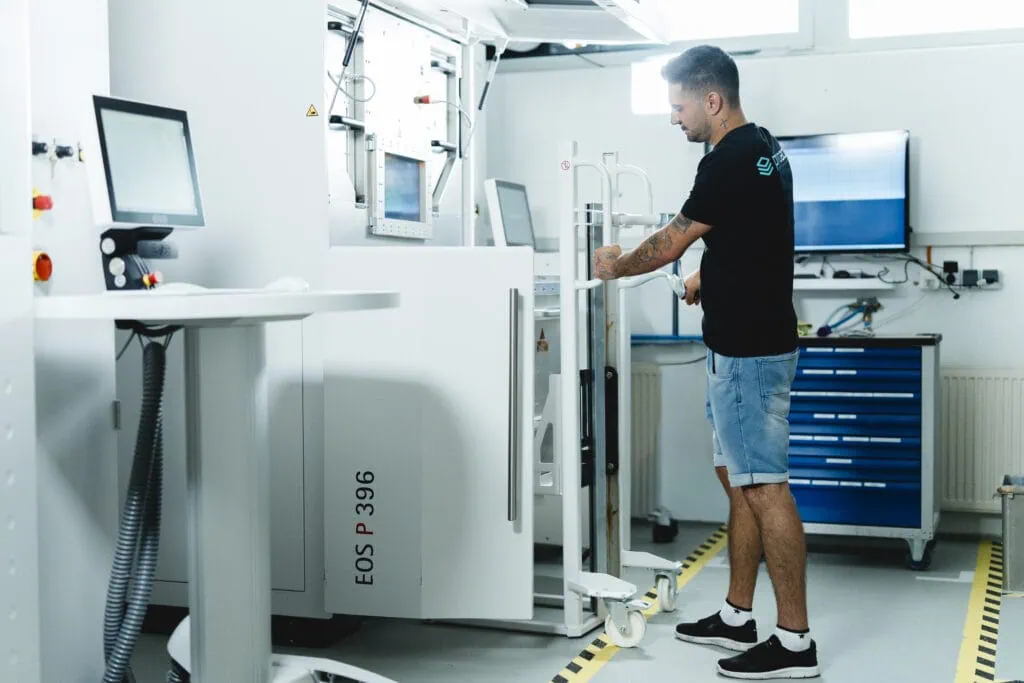
The EOS P396 laser sintering system is a real workhorse – whether for the production of large one-piece prototypes or for the additive series production of smaller to medium-sized components, our P396 machines are ready!
Technical data
Build space: 340 x 340 x 600 mm
Laser type: 70W CO₂ laser
Scanning speed: up to 6 m/s
Frequently Asked Questions – SLS Machine Fleet
At prioadd only industrial SLS 3D printing systems from EOS in Munich are used. Our machine fleet consists of EOS Formiga P100, EOS Formiga P110, as well as EOS P396 systems. Overall, we operate several modern laser sintering systems that are specifically designed for the reliable production of functional plastic components. EOS machines are considered particularly precise and robust and are established worldwide in industrial 3D printing.
The machines in the EOS P1 series are particularly well suited for delicate components and prototypes where a high level of detail is required. In addition, these systems enable us to produce smaller components very efficiently in series or, if required, respond quickly to express orders.
The EOS P396 is primarily used for larger components or for cost-effective series production. Thanks to its larger build volume, both large individual parts and many smaller parts can be produced simultaneously.
The “P” stands for polymer and, for EOS 3D printing systems, designates machines designed for processing plastic powders using the SLS process. Models such as the EOS P110 or EOS P396 therefore belong to EOS’s polymer series and are used for the additive manufacturing of plastic components.
A CO₂ laser is used in SLS 3D printing systems because its wavelength is absorbed particularly well by plastic powders such as polyamide. This allows the material to be melted efficiently and evenly. At the same time, the CO₂ laser enables very precise control of the energy, producing fine details and stable components in the laser sintering process.
Scan speed describes the speed at which the laser beam is guided across the powder layer during SLS 3D printing. During the printing process, the laser traces the contours and surfaces of the component and fuses the plastic powder layer by layer. Scan speed is an important process parameter, as it influences component quality, surface texture, and the mechanical properties of the printed parts.