


Selective Laser Sintering
Post-processing and Surface Technology
Additional Services
Chemical Smoothing of SLS 3D Printed Parts
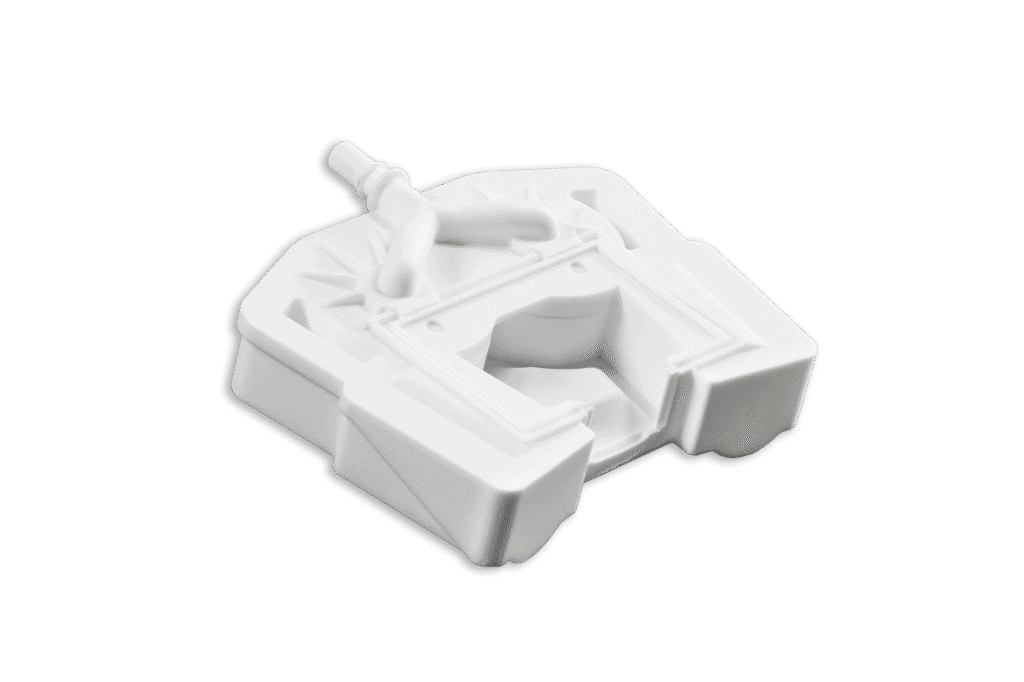
In chemical smoothing, the surface of SLS components is specifically dissolved by a solvent to achieve smoothing and sealing. This process gives the surface a quality comparable to that of injection-molded parts and makes it less prone to dirt adhesion. The pores are completely sealed, making chemically smoothed SLS parts 100% pressure-tight. The chemical smoothing of 3D-printed components made of PA2200 does not affect their biocompatibility and food contact certification.

Advantages of Chemical Smoothing
Ideal for parts that…
-
must be 100% pressure-tight, such as pipe connectors, seals, vacuum grippers, or air ducts.
-
should be easy to clean, because the sealed surface makes it easy to wipe off chemically smoothed SLS parts.
-
require a smoother, optically higher-quality surface at injection molding level.
-
need to be smoothed without material removal.

Possible Surfaces
SLS 3D-printed components made of PA2200 (PA12 white) without special post-processing have an approximate surface roughness of Ra=11.7 µm and Rz=64.6 µm. Chemical smoothing can improve these roughness values to Ra=2.4 µm and Rz=12.3 µm. The chemical smoothing of 3D-printed components made of PA2200 does not affect their incompatibility and food contact certification.
How Chemical Smoothing Works
In the chemical smoothing process, the SLS parts, which have been completely freed from residual powder, are first suspended in the process chamber of the chemical smoothing system. Subsequently, the air is extracted from the process chamber and a slightly warm solvent vapor is introduced into the chamber. This vapor condenses on the surface of the components and slightly dissolves them. After a few minutes, the solvent atmosphere is extracted from the process chamber and the process chamber is reflooded with normal air. In normal air, the surface of the part solidifies again and is now smoother than before and completely sealed.
Compatible Materials
- PA2200 (PA12 white)
- PA2201 (PA12 translucent)
- PA3200GF (PA12 glass-filled white)
- Alumide (PA12 with Aluminum)
- PA2241FR (PA12 flame-retardant white)
- PA2210FR (PA12 flame-retardant white)
- PA1101 (PA11 white)
- TPU1301 (TPU white)
Frequently Asked Questions - Chemical Smoothing
During chemical smoothing, the surface of SLS components is with a solvent vapor controlled partially dissolved. As a result, the topmost material layers flow slightly and the surface becomes significantly smoother and simultaneously sealed.
This process gives components a very smooth surface that can be visually and haptically comparable to injection-molded parts. At the same time, the pores on the surface are closed, making the components easier to clean and less prone to dirt adhesion.
Yes. By sealing the surface pores, can chemically smoothed SLS components become 100% pressure-watertight . The process is therefore particularly suitable for components such as pipe connectors, air ducts or vacuum grippers.
During chemical smoothing, is only the topmost material layer treated, while the core of the component remains unchanged. As a result, the mechanical properties largely remain intact, while surface and haptics are significantly improved .
Chemical smoothing is particularly suitable when a very smooth and virtually non-porous surface is required. The process completely seals the pores of the SLS components and can even make components 100% pressure-watertight. In contrast, vibratory finishing is usually more cost-efficient and primarily improves the haptics and surface roughness without completely sealing the pores. Therefore, chemical smoothing is mainly used for components that require high tightness or a particularly high-quality surface.