


Selective Laser Sintering
Post-processing and Surface Technology
Additional Services
Mechanical Post-processing of SLS 3D Printed Parts
Due to the process, laser-sintered components are subject to approximately the following symmetrical tolerance ranges, depending on the nominal dimension:
| Nominal Dimension | Tolerance Range |
|---|---|
| 0 to 30 mm | ± 0.2 mm |
| 30 to 100 mm | ± 0.3 mm |
| From 100 mm | ± 0.3% of the nominal dimension |
However, some SLS parts must meet stricter tolerances to ensure their functionality. To achieve this, the components can be mechanically post-processed after the 3D printing process, e.g., with a CNC milling machine, a drilling machine, or a tap. For CNC post-processing, we can utilize the machinery of our partner priomold, which includes over 20 milling machines. The melting in of threaded inserts also falls under the category of mechanical post-processing.
Benefits of Mechanical Post-processing
Ideal for parts that…
- must meet a tight tolerance range in certain areas
- require precise boreholes with fits for their function
- require durable metal threaded inserts

CNC Milling of SLS Parts
Post-processing laser-sintered components on a milling machine ensures that tighter tolerance ranges can be met in certain areas of the component than are possible directly with the SLS process. For example, holes can be precisely positioned, surfaces can be milled flat to meet stricter parallelism requirements, or inner and outer diameters can be re-milled to achieve more exact diameters. For the mechanical post-processing of SLS parts, we can rely on the expertise of our partner priomold.
Fits and Threads
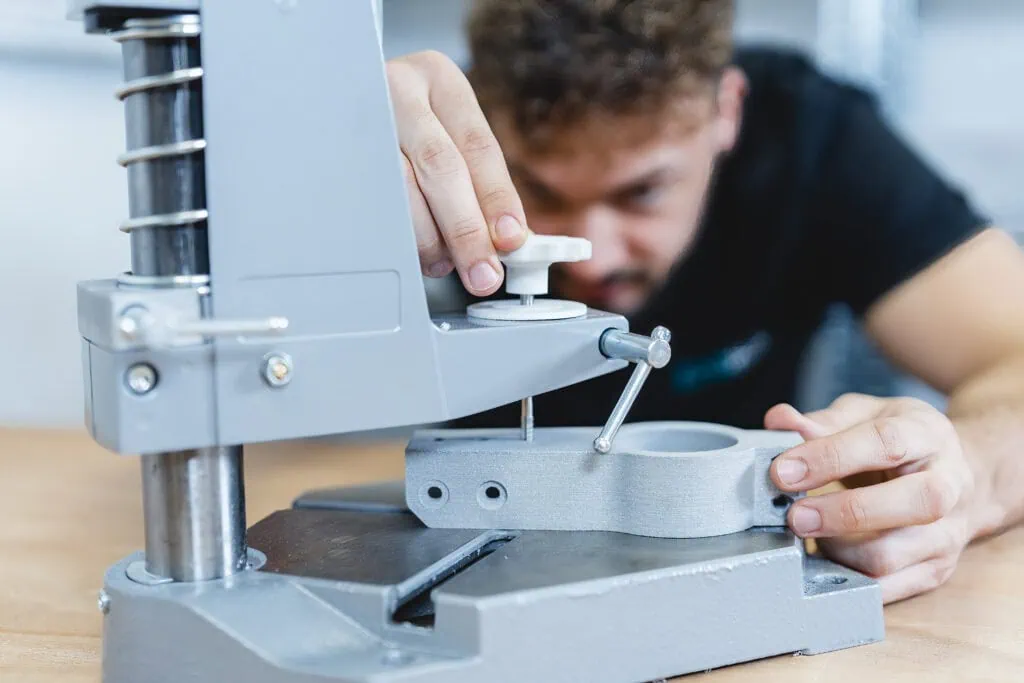
During Selective Laser Sintering, inner diameters tend to shrink or fuse. By re-drilling these holes on a drill press, for example with a reamer, laser-sintered parts with precise boreholes and fits can be produced. If the corresponding pilot hole is provided in the component before the printing process, threads can also be cut directly into the component after the printing process. Tip: Threads from M4 upwards can also be produced directly using the SLS process.

Melting in Threaded Inserts
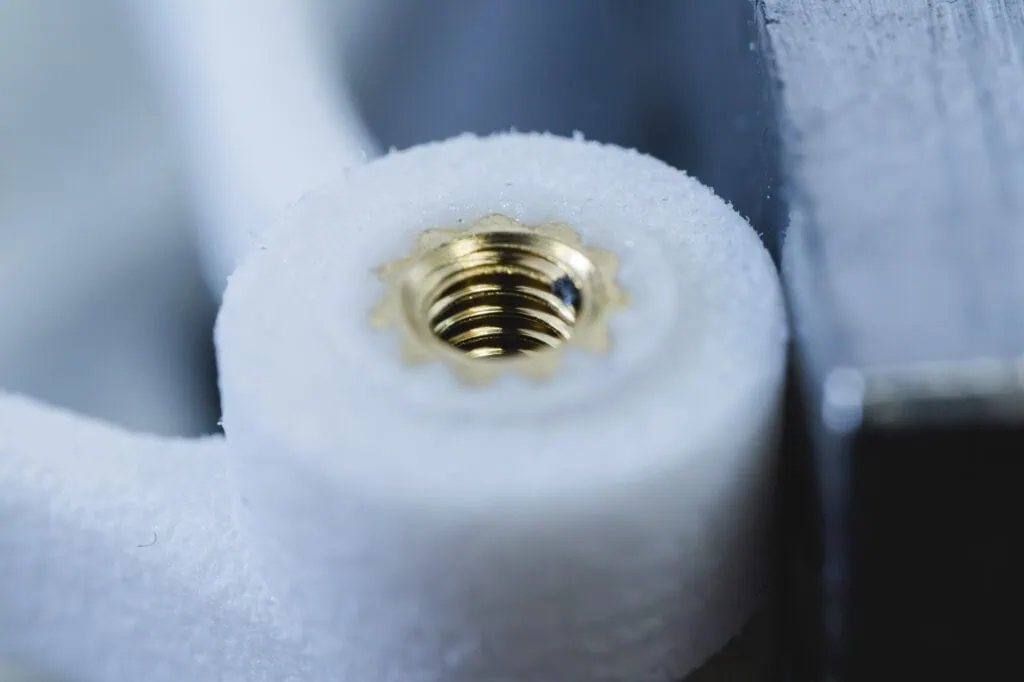
Melting in threaded inserts with a soldering iron is the most robust and durable way to incorporate threaded inserts into a plastic SLS part. We maintain a large stock of threaded bushings to quickly supply even complex components with threaded bushings. Ideally, the component should already have a suitable bore at the respective location. If you require assistance with this, please feel free to contact us!

Compatible Materials
- PA2200 (PA12 white)
- PA2201 (PA12 translucent)
- PA3200GF (PA12 glass-filled white)
- Alumide (PA12 with Aluminum)
- PA2241FR (PA12 flame-retardant white)
- PA2210FR (PA12 flame-retardant white)
- PA1101 (PA11 white)
Frequently Asked Questions – Mechanical Post-Processing
In SLS 3D printing, certain dimensional tolerances occur due to the process and depend on the nominal dimension of the component. For components with a nominal dimension of 0 to 30 mm, the typical tolerance range is around ±0.2 mm. In the 30 to 100 mm range, the tolerance is approximately ±0.3 mm, and for larger components from 100 mm, it is around ±0.3% of the respective nominal dimension. If tighter tolerances or very precise fits are required, these can be achieved through mechanical post-processing such as drilling, reaming, or milling.
Yes. Metal threaded inserts can be heat-set into SLS components. This method provides particularly robust, durable threads that work reliably even with frequent assembly. We keep the required threaded inserts in stock at prioadd in common sizes, so they can be integrated into components quickly.
Yes. For CNC post-processing, prioadd prioadd can use the machinery of its partner priomold, which has numerous milling machines. Both companies are located in the same building, so mechanical processing can be carried out quickly and without additional transport routes.
Yes. Threads can be printed directly in SLS 3D printing. Smaller threads such as M 2 are usually tapped afterwards to achieve higher precision. From M4 threads can usually be produced and used directly in the print. However, if a thread is frequently assembled and disassembled, metal threaded inserts are recommended to ensure a longer service life.
In SLS 3D printing, dimensional tolerances in the tenths range and slightly rough surfaces occur due to the process. However, if very accurate fits are required—for example for bearings, shafts, or precise plug-in connections—it may be advisable to ream the bore afterwards. This allows the diameter to be set precisely and achieves a uniform, precise surface for the fit.