


SLS – Selective Laser Sintering in Industrial 3D Printing
SLS 3D Printing
The SLS process (Selective Laser Sintering) is one of the most important technologies in industrial 3D printing. The process enables the production of complex and durable plastic components without tooling. Laser sintering has become particularly established in the additive manufacturing of functional components, prototypes, and series production, as it combines high design freedom with excellent mechanical properties. The layer-by-layer manufacturing process enables geometries that are often difficult or impossible to achieve with conventional manufacturing methods.
How does the SLS process work?
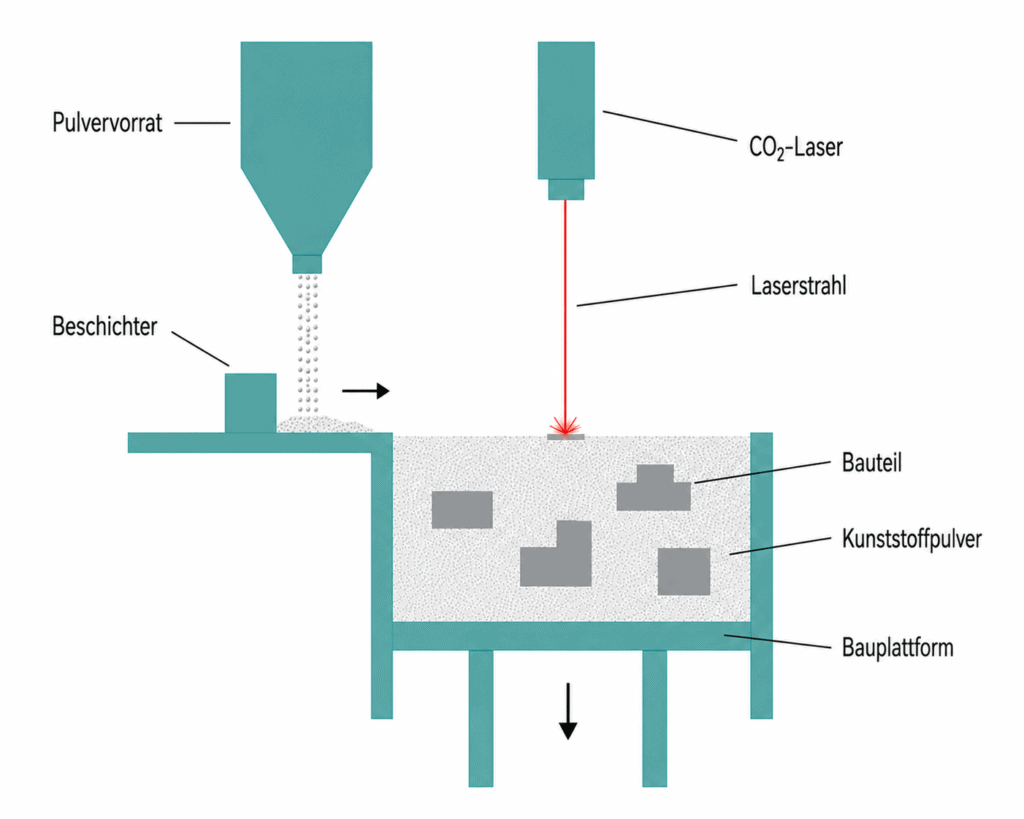
Application of Plastic Powder
At the beginning of the SLS process, a recoater distributes a thin layer of plastic powder evenly across the build platform. The layer thickness is typically approximately 0.1 mm. The powder is distributed uniformly throughout the build chamber, creating a level surface for the next manufacturing step. Thermoplastic materials such as PA12, PA11, or TPU are used as starting materials.
Fusing by Laser
After applying the powder layer, a CO₂ laser traces the previously defined areas of the current layer. The powder is locally heated until the individual particles fuse together. Only the areas that will later be part of the component are processed by the laser. The surrounding powder remains unchanged and stays loose in the build chamber.
Lowering the Build Platform
Once a layer has been completely fused, the build platform lowers by the height of the next layer. The layer thickness remains identical to the previous layer. This creates space for the reapplication of a uniform powder layer.
Layer-by-Layer Component Construction
After fusing a layer and lowering the platform, steps 1 through 3 are repeated until the last layer has been fused by the laser.
Depowdering and Post-Processing
Once all layers have been built, the entire build chamber cools down in a controlled manner. The finished components are then removed from the excess powder and cleaned by blasting with glass beads. Unfused powder can subsequently be reused for further printing processes.
Advantages of Selective Laser Sintering
A major advantage of the SLS process lies in the excellent mechanical properties of the printed components. Commonly used materials such as PA12, PA12+glass, PA12+aluminum, or PA11 offer high stability, good temperature resistance, and good chemical resistance. This makes laser sintering suitable not only for visual models but especially for functional applications and technical end-use components. At the same time, the powder bed process produces homogeneous and durable plastic parts with high dimensional accuracy and uniform material structure.

Compared to many other additive manufacturing processes, the SLS process does not require additional support structures. This allows even complex geometries, internal channels, or moving components to be manufactured without extensive additional post-processing, reducing production costs. Due to the high process speed and the ability to manufacture multiple components simultaneously within a single build job, Selective Laser Sintering is particularly suitable for the cost-effective production of small series and series components.
Difference Between SLS, SLA, and FDM
Compared to other 3D printing processes such as SLA or FDM, Selective Laser Sintering offers decisive advantages for industrial applications.
In the FDM process, molten plastic is applied layer by layer through a nozzle. This often results in visible layer lines and lower mechanical properties.
The SLA process, on the other hand, works with liquid resin that is cured using UV light. While SLA enables very fine surfaces and high detail accuracy, the components are often more brittle and less durable than SLS components.
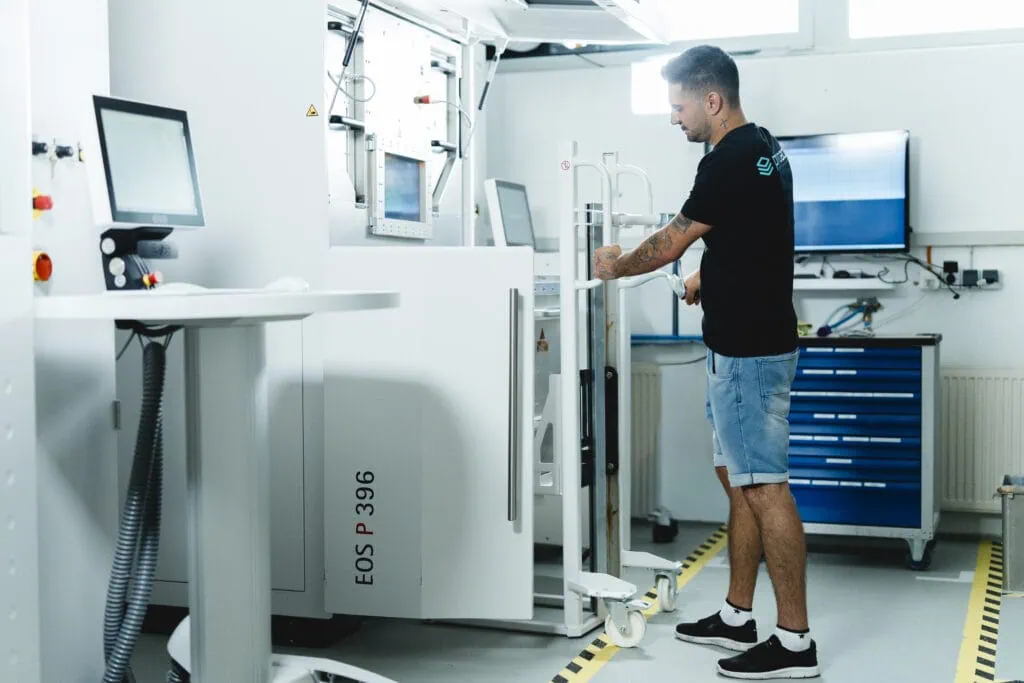
The SLS process, on the other hand, combines high stability, good surface quality, and maximum design freedom, making it particularly suitable for functional plastic components and industrial series applications.
Applications of SLS 3D Printing
By eliminating tooling costs and the ability to manufacture multiple components simultaneously within a single build job, laser sintering is particularly cost-effective for prototypes and small series. At the same time, the process enables rapid iterations during product development and significantly shortens development times.

Due to the good mechanical properties of the plastics used, the SLS process is also suitable for robust and ready-to-install functional components that can be used directly in technical applications. Customized or customer-specific components can also be manufactured cost-effectively without additional tooling costs. Furthermore, functional elements such as film hinges, snap hooks, or movable joints can be printed directly. This creates components with high functional integration, where multiple functions or assemblies can be combined in a single component.
The SLS process is used today in numerous industries—including mechanical engineering, the automotive industry, aerospace, medical technology, the electronics industry, and motorsports. Typical applications include housings, brackets, air ducts, functional prototypes, fixtures, spare parts, or ready-to-assemble series components.
Frequently Asked Questions - SLS Process
SLS stands for “Selective Laser Sintering.” It is an additive manufacturing process in which plastic powder is fused layer by layer into a component using a laser.
The SLS process offers high design freedom, good mechanical properties, and the ability to produce complex geometries without additional support structures.
The SLS process primarily uses technical plastics such as PA12, PA12+glass, PA12+aluminum, or PA11. Depending on the application, special materials are also available, such as TPU for flexible or elastic components, or flame-retardant materials for use in environments with increased fire protection requirements.
In the FDM process, molten plastic is applied through a nozzle. The SLS process, on the other hand, works with plastic powder and a laser. This produces more stable and complex components with SLS without additional support structures.
SLA uses liquid resin that is cured by UV light. The process enables very fine details and smooth surfaces. SLS components, on the other hand, are usually more mechanically durable and better suited for functional technical applications.
No. The surrounding powder stabilizes the components during the printing process. This allows even complex geometries to be manufactured without additional supports.
The SLS process is particularly suitable for functional prototypes, technical components, spare parts, small series, and industrial series production in a wide variety of industries.
We are a young team with great passion for industrial 3D printing and additive manufacturing. We enjoy testing limits and support our customers even when projects need to be implemented on very short notice. Through our experience in SLS 3D printing, we can realize even complex components and demanding projects quickly and efficiently.
Personal contact is particularly important to us. We see our customers not just as clients, but as long-term partners. That is why we accompany projects from the initial idea to the finished component with direct communication, technical support, and fast response times.